Predictive Home Security AI: Detecting Threats Before the Break-In Happens
Predictive home security AI is fundamentally changing what a security system does. For decades, alarm systems have been reactive by nature — they detect an intrusion after it has begun, sound an alarm, and alert the monitoring centre. The break-in has already happened. The intruder is already inside. The damage, both physical and psychological, has already started. Predictive AI shifts the entire model by detecting the behaviours that precede a break-in, generating alerts and triggering deterrents before the intruder ever crosses the threshold.
This shift from catching crime to preventing crime represents the most significant evolution in residential security since the introduction of monitored alarm systems. Instead of documenting what happened, predictive security systems intervene during the decision-making window when a potential intruder is still assessing the property, testing vulnerabilities, and deciding whether to proceed.
Understanding Pre-Intrusion Behaviour
Burglaries are rarely impulsive acts. Research into offender behaviour consistently shows that most residential break-ins involve a period of reconnaissance and assessment before the intruder commits to entry. This pre-intrusion phase typically includes observable behaviours that AI systems can be trained to recognise.
Common Pre-Intrusion Behaviours
Criminological research identifies several behaviours that frequently precede residential burglary:
- Loitering: A person remaining in the vicinity of a property for an extended period without apparent purpose, often returning multiple times
- Property scanning: Walking or driving past a property repeatedly while looking toward it, assessing entry points, camera positions, and signs of occupancy
- Door and window testing: Approaching entry points and physically testing whether they are locked, often under the pretence of knocking or delivering something
- Checking for occupancy: Knocking on doors, ringing doorbells, and watching for signs of response before attempting entry
- Barrier assessment: Examining fences, gates, and side passages for weaknesses or access points
- Unusual approach patterns: Arriving on foot from an unusual direction, using rear or side approaches rather than the front entrance, or approaching during unusual hours
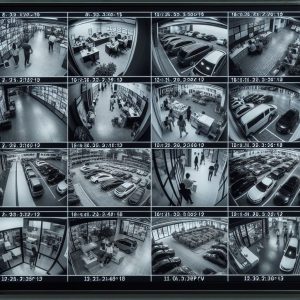
Traditional security cameras record all of these behaviours but do nothing with them in real time. The footage sits on the NVR, potentially useful after a break-in but entirely passive during the critical window when intervention could prevent the crime entirely.
How Predictive AI Detects These Behaviours
Predictive security AI uses deep learning models trained on vast datasets of normal and suspicious behaviour to distinguish between routine activity and patterns that indicate potential criminal intent. The technology operates through several layers of analysis that work together to build a threat assessment.
Object Classification
The first layer identifies what is in the scene — person, vehicle, animal, or environmental movement. This basic classification eliminates the majority of false triggers by ignoring non-human movement entirely. Modern AI achieves better than 95 percent accuracy in person detection under normal conditions.
Behavioural Analysis
Once a person is detected, the AI analyses their behaviour against models of normal and suspicious activity. How long are they in the area? Are they moving with purpose or lingering? Are they approaching the property directly or circling it? Are they interacting with entry points? The behavioural analysis layer converts raw movement data into behavioural classifications that carry security significance.
Contextual Assessment
The AI considers context to reduce false positives. A person standing near your front door at 2 PM on a weekday might be a delivery driver — especially if they are carrying a parcel and leave within a minute. The same behaviour at 2 AM, with no parcel and an extended duration, carries a very different risk profile. Time of day, day of week, historical patterns for the property, and the specific zone where the behaviour occurs all factor into the threat assessment.
Pattern Recognition
Predictive systems track patterns across time. If the same person — or someone matching a similar description — appears near your property on multiple occasions without a clear legitimate purpose, the system escalates the alert level. This temporal pattern analysis catches the reconnaissance phase that often occurs days before an attempted entry.
What Happens When Suspicious Behaviour Is Detected
The value of predictive detection depends entirely on what happens next. Detecting a potential threat is only useful if the system triggers an effective response during the pre-intrusion window.
Automated Deterrents
Predictive security systems can trigger automated deterrents designed to interrupt the pre-intrusion assessment and convince the potential intruder that the property is actively monitored and not a viable target.
Common automated responses include:
- Lighting activation: Floodlights or spotlights activate in the area where the suspicious behaviour is detected, signalling that the person has been noticed
- Audio warnings: A pre-recorded message plays through an outdoor speaker, informing the individual that they are being recorded and that the property is monitored
- Camera tracking: PTZ cameras automatically track the individual, and some systems activate a visible red tracking light to make the person aware they are being followed
- Siren activation: For higher-threat assessments, a brief siren burst can be triggered to signal that the security system has been activated
Intelligent Alerts
Unlike basic motion alerts that simply notify you that movement was detected, predictive alerts include context that helps you assess the situation quickly. A typical predictive alert might include: “Person detected loitering near rear fence for 3 minutes at 11:47 PM. No matching vehicle in driveway. Behaviour classification: suspicious. Floodlights activated.” The alert includes video clips showing the detected behaviour, allowing you to make an informed decision about whether further action is needed.
Monitoring Centre Escalation
For professionally monitored systems, predictive alerts can be escalated to the monitoring centre before any alarm event occurs. The monitoring centre operator receives the same contextual information — video, behavioural classification, duration, and location — and can take proactive action such as activating two-way audio to challenge the individual, dispatching a patrol, or contacting the homeowner.
The Effectiveness of Early Intervention
The logic behind predictive security is supported by research into situational crime prevention. The theory holds that most criminal acts are rational decisions influenced by perceived risk, effort, and reward. If a potential intruder assesses a property and encounters evidence that the property is actively monitored — lights activating, cameras tracking, audio warnings — the perceived risk of detection increases sharply, and the rational decision is to move on.
Studies on deterrence effectiveness consistently show that active, visible security measures are more effective than passive ones. A camera that visibly tracks a person’s movement is a stronger deterrent than a static camera that may or may not be monitored. A light that activates in response to their specific presence is more impactful than a light on a timer. Predictive AI enables these responsive, targeted deterrents that directly address the specific behaviour occurring in the moment.
The best security outcome is not catching a burglar — it is convincing them to choose a different target. Predictive AI makes your property the one that is clearly too well-monitored to risk, shifting the threat to less protected properties.
Practical Considerations for New Zealand Homeowners
Predictive security capabilities are available in both self-monitored and professionally monitored systems, at a range of price points suitable for New Zealand homeowners.
Several current-generation camera and alarm platforms offer built-in predictive analytics. These systems include AI-powered cameras that perform behavioural analysis on-device, generating alerts and triggering automations without requiring cloud processing or additional hardware. The setup typically involves defining detection zones, setting sensitivity thresholds for different behaviour types, and configuring the desired automated responses.
For homeowners who want the highest level of predictive protection, professional installation ensures optimal camera positioning for behavioural analysis, correct configuration of detection parameters to minimise false positives while catching genuine threats, and integration with a monitoring centre that can take proactive action on pre-intrusion alerts.
The most effective predictive security systems combine AI detection with multiple response mechanisms — lighting, audio, camera tracking, and human monitoring — to maximise the deterrent effect during the critical pre-intrusion window. This layered response approach ensures that even if one deterrent fails to dissuade the potential intruder, subsequent layers increase the perceived risk until the decision to proceed becomes irrational.
Predictive home security AI does not eliminate the need for traditional alarm systems — the reactive layer remains essential for situations where deterrence fails. But by adding a predictive layer that engages before the break-in occurs, homeowners gain something traditional alarms never offered: the genuine possibility of preventing the crime entirely.